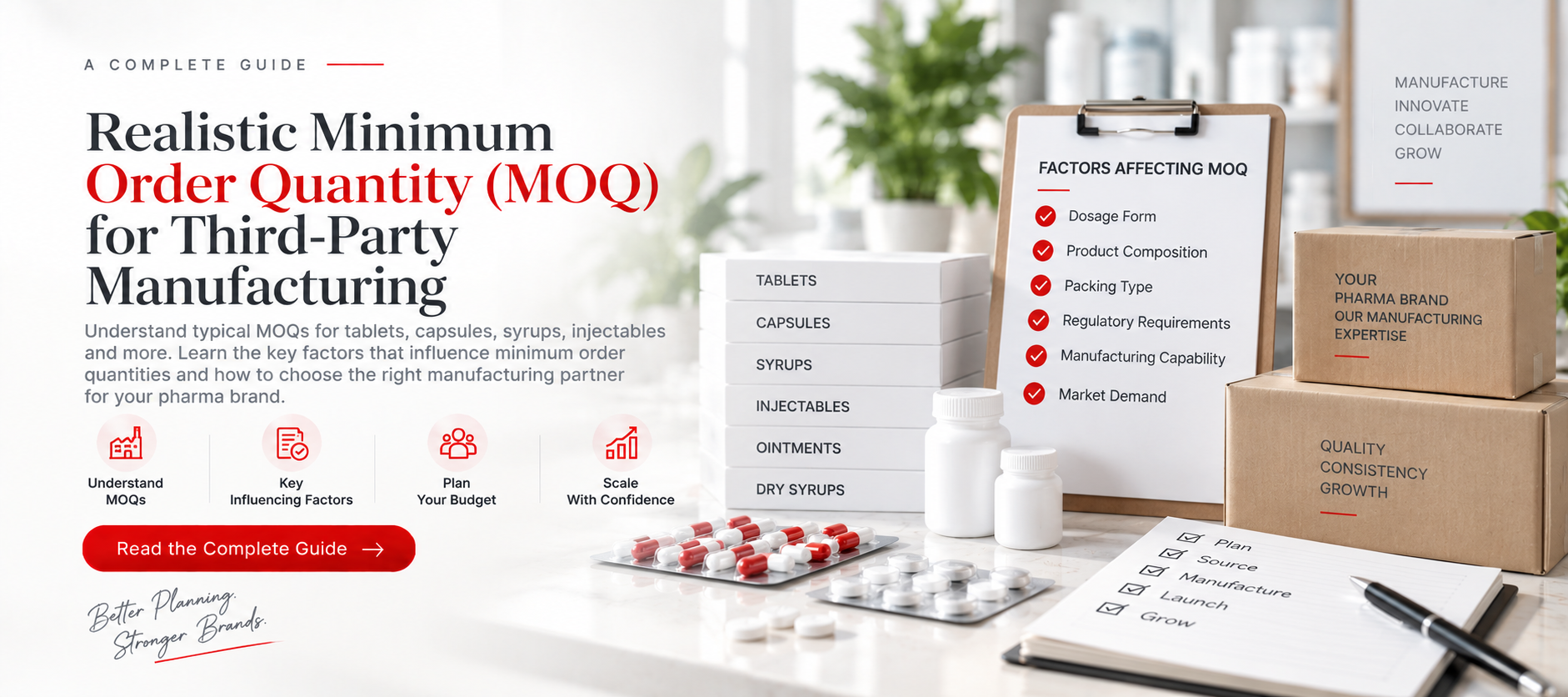
One of the most common questions asked by entrepreneurs, traders, doctors and existing pharma businesses is: “What is the minimum order quantity for third party manufacturing?” The honest answer is that MOQ depends on the product, dosage form, batch size, packaging format, machine economics and the specific manufacturer’s process.
There is no single universal number. What is important for your business is to understand why MOQ exists, what is realistic for your stage of business, and how to evaluate whether an MOQ is commercially viable for you.
1. What Is Minimum Order Quantity (MOQ) in Third Party Manufacturing?
MOQ is the smallest quantity of a product that a manufacturer is willing to produce in a single production batch or contract. It is set by the manufacturer based on production economics, not by government regulation.
For example, a tablet manufacturer may state an MOQ of a fixed number of tablets per batch because setting up the tablet compression machine, tooling and blending process takes time and labour. The cost of that setup has to be covered by the quantity produced.
Where MOQ comes from in pharma manufacturing
- Machine setup time: Cleaning, sterilization, calibration and trial runs are required before each batch.
- Batch production economics: Larger batches spread fixed manufacturing costs across more units, reducing cost per unit.
- Packaging line setup: Blister packing, bottle filling and labelling machines also need batch-level setup.
- Regulatory documentation: Every batch must be tested, documented and released by quality control, adding fixed documentation effort per batch.
2. What Determines the Cost and MOQ in Pharma Manufacturing?
Before evaluating MOQ, you should understand what drives manufacturing cost. This helps you judge whether a manufacturer’s MOQ is realistic or inflated.
| Factor | How It Affects MOQ and Cost |
|---|---|
| Product & Molecule | Simple, common molecules usually have lower manufacturing complexity. Specialized or patented-like formulations may need more process validation. |
| Dosage Form | Tablets and capsules typically have simpler setups than syrups, suspensions, injectables or complex preparations. |
| Packaging Format | Blister packs, bottles and tubes have different line setup times and material costs. |
| Production Volume | Higher batch quantities usually reduce the cost per unit because fixed costs are spread over more units. |
| Raw Material Sourcing | Availability and quality of raw materials can affect both MOQ feasibility and pricing. |
| Manufacturer’s Capability | Large-scale manufacturers may have high minimum runs; smaller units may be more flexible for first-time entrepreneurs. |
| Testing & Documentation | Every batch needs QC testing and documentation, adding a fixed cost component per batch. |
For an entrepreneur evaluating a product range, you can use our practical guide on choosing the best PCD pharma product portfolio for your region to understand which products are more commercially practical to start with.
3. What Is a Realistic MOQ for New Businesses?
Many new entrepreneurs fear that third party manufacturing requires an enormous upfront investment. In reality, many manufacturers work on monthly production quantities that are linked to your expected market demand rather than asking for a single huge upfront order.
Many manufacturers produce one batch per month based on your expected demand. This spreads investment across time instead of demanding one large payment upfront.
Start with a small, realistic batch for 3–6 months of expected demand. Once repeat demand is visible, scale production in the next cycle.
Producing 5–10 well-selected products is often more practical than 50–100 products in a single batch.
Ensure you have funds not only for manufacturing but also for GST, freight, stock storage, expiry buffer and market promotion.
4. How to Calculate Total Third Party Manufacturing Cost
Before placing a manufacturing order, calculate your total cost per batch, not just the manufacturing price quoted by the manufacturer.
Ask for a written quotation per product, per batch, per packing size, including testing and documentation charges.
Add packaging, GST, freight, and any quality testing charges to get the true batch cost.
Check the market price you can realistically achieve for the product in your territory.
Divide total batch cost by your estimated per-unit margin to understand how many units you must sell to recover your investment.
This type of analysis is important before you start. Our detailed guide on average profit margins in a PCD pharma franchise explains how operating costs can affect the final profit from your pharma business.
5. How to Negotiate Better MOQ and Payment Terms
Many entrepreneurs assume MOQ is fixed and non-negotiable. In practice, manufacturers are often willing to discuss batch sizes, product selection and payment terms, especially for long-term partnerships.
6. How to Reduce Expiry and Working Capital Risk
Large batches can create serious working capital and expiry problems if demand does not match expectations. This is especially important in the pharmaceutical business, where products have a limited shelf life.
Producing a 12-month quantity for a new product can create expiry risk if demand is slower than expected.
Production capacity and sales capacity are different. Producing more than you can sell creates stock blocking.
Always factor in some stock that may expire, especially for new products whose demand is not yet validated.
Estimate your monthly sales realistically before deciding batch quantity.
For practical expiry management guidance, read our article on managing expired and broken drug stock in a PCD pharma franchise agreement.
7. Documentation Needed for Third Party Pharma Manufacturing
Once you decide on your product range and manufacturer, the documentation process is the next important step. The manufacturer may ask for some or all of the following:
For a broader understanding of the documents commonly needed to partner in the pharma business, see our guide on documents required to partner with a certified PCD pharma company.
8. Why Discuss Your Manufacturing Plan with Mensa Medicare
Whether you are planning to start your own brand through third party manufacturing or looking for a manufacturing or franchise partner, the initial decisions about product selection, batch quantity, pricing and working capital should be made carefully.
Mensa Medicare supports PCD pharma franchise and manufacturing-related enquiries from entrepreneurs, doctors, traders and existing pharma businesses. When you contact the team, you can discuss:
- Your target market and product interest areas.
- The product range and formulation categories you wish to explore.
- Commercial terms, manufacturing or franchise processes, and documentation requirements.
- Current territory availability and product availability where relevant.
- Practical planning support to align production quantity with expected demand.
9. Third Party Manufacturing Checklist Before Placing Your First Order
Before you commit funds to a manufacturing batch, confirm the following points:
Discuss Your Third Party Manufacturing Plan with Mensa Medicare
Share your target market, product interest and planned investment to receive relevant commercial information and planning guidance from the Mensa Medicare team.
Third Party Manufacturing MOQ — FAQs
A realistic MOQ depends on the product, dosage form, packing size and manufacturer. As a general guide, many third party pharma manufacturers work with monthly production batches rather than asking every new client for a very large opening order. The practical way to check MOQ is to ask the manufacturer for the batch quantity per product and per packing size.
Yes. Tablets, capsules and syrups may have different machine setup requirements and batch economics. Smaller pack sizes usually have higher per-unit costs, while larger quantities and bulk orders can reduce the cost per unit within standard commercial limits.
New businesses should be careful before committing large funds to stock. It is generally better to start with smaller, manageable batches, validate market demand, and then scale production once repeat demand is visible. This reduces expiry risk and working-capital pressure.
Common documentation includes your business identity and GST details, applicable drug licence where required, product composition and label information, and a signed manufacturing agreement. The exact documentation may vary by state, product category and the manufacturer's process.
Mensa Medicare handles PCD pharma franchise and manufacturing-related enquiries through its team. Prospective business partners can contact the team to discuss product range, commercial terms, documentation and manufacturing or franchise suitability for their business plan.