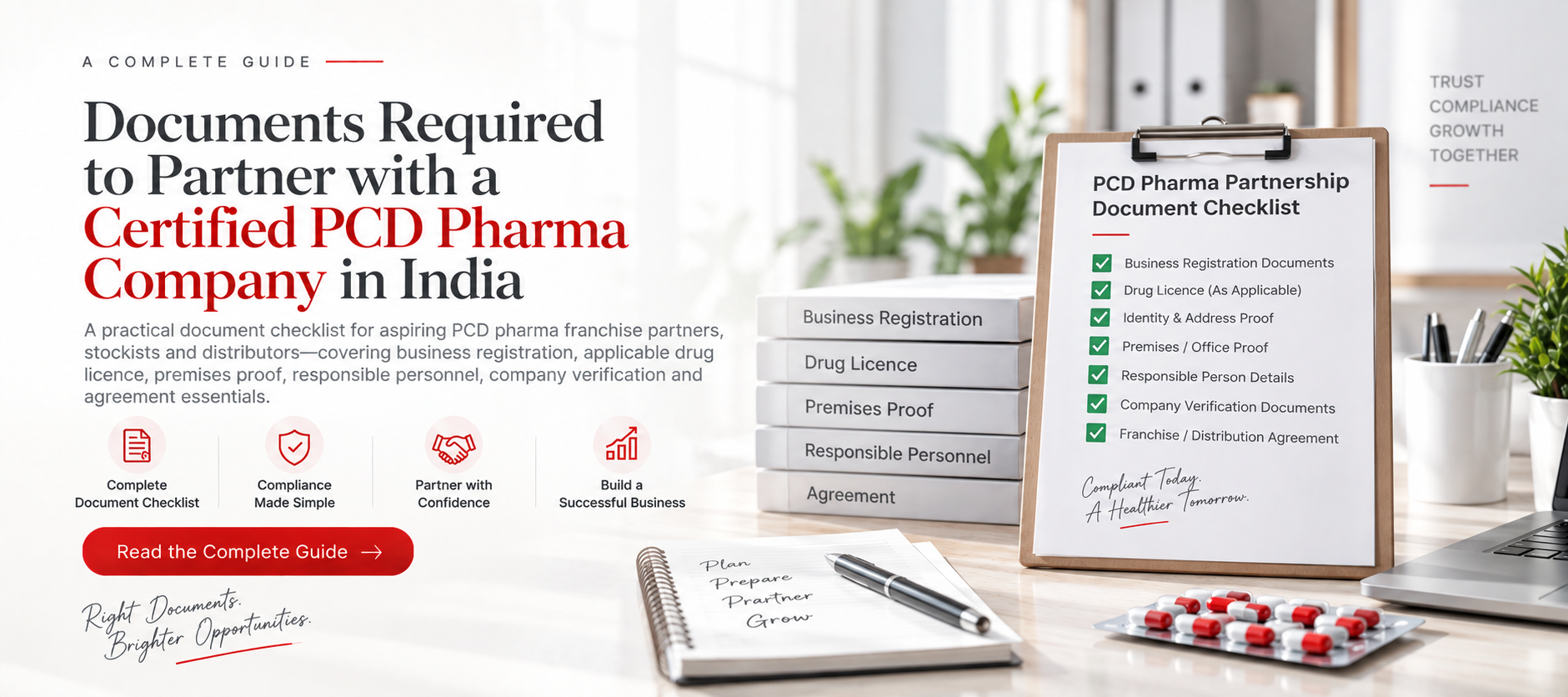
Before investing in a PCD pharma franchise business, it is important to prepare the right documents and verify the company you plan to work with. Documentation is not only a formality—it protects your business, helps you remain compliant, and ensures that pricing, territory rights, product supply and commercial responsibilities are clearly recorded.
The exact papers required can vary by state, product range, business structure and the role you will perform. For example, a person who only supports marketing may have different requirements from a partner who purchases, stores, invoices and distributes pharmaceutical products under their own firm name.
1. Understand Your Role Before Preparing Documents
The documents you need depend on the business model you choose. Before collecting paperwork, clarify whether you are becoming a marketing partner, a wholesale distributor, a stockist or a PCD franchise partner with direct billing responsibility.
| Business Model | Typical Activity | Documentation Focus |
|---|---|---|
| PCD Marketing Partner | Promotes pharmaceutical products in an allotted area while supply and invoicing may be managed through an authorised distributor. | Identity proof, business details, territory agreement and company-specific onboarding documents. |
| Wholesale Distributor / Stockist | Purchases, stores, invoices and supplies medicines to licensed retailers, hospitals or other authorised buyers. | Applicable wholesale drug licence, GST details, premises proof, competent person records and business registration. |
| Retail + Wholesale Setup | Operates both a retail pharmacy and a wholesale distribution activity, subject to applicable permissions. | Separate or combined regulatory approvals, premises compliance and qualified supervision as applicable. |
| Third-Party Licensed Distribution Model | Marketing activity is coordinated through an already licensed distributor or stockist. | Written commercial arrangement, billing clarity, product traceability and confirmation of the licensed party's role. |
2. Core Business Documents Required from the Franchise Partner
Most PCD pharma companies request basic identity, business and financial documents before appointing a franchise partner. These records help the company verify who it is contracting with and allow correct invoicing, GST documentation and payment processing.
3. GST Registration and Banking Documents
PCD pharma transactions involve invoices, taxes, credit notes, stock returns and payment records. For this reason, your supplier may request GST and banking details as part of the onboarding process.
- GST Registration Certificate: GSTIN details, legal business name and principal place of business details, where applicable.
- Cancelled Cheque: A cancelled cheque or bank account proof in the name of the business entity used for payments and refunds.
- Bank Account Details: Account holder name, bank name, IFSC code and account number for formal payment records.
- GST Address Consistency: Ensure that the GST certificate, drug licence, invoice address and agreement address do not have unexplained mismatches.
4. Drug Licence Documents for Pharma Distribution
If you intend to purchase, store, invoice or supply medicines from your own premises, the most important compliance document is generally the applicable drug sale licence issued by the State Drug Control Authority.
For wholesale pharmaceutical distribution, many businesses obtain the applicable wholesale licences under the Drugs and Cosmetics Rules. The categories, forms and conditions depend on the products you handle and the regulations followed by your state licensing authority.
| Document / Requirement | Why It Matters | What to Check |
|---|---|---|
| Wholesale Drug Licence | Authorises the sale and distribution of eligible pharmaceutical products from the licensed premises. | Check licence number, issue date, licensed address, product scope and validity/retention requirements. |
| Competent Person Approval | Demonstrates that the business has qualified supervision for wholesale drug operations, as required by the authority. | Confirm that the approved person's details match the licence and current employment arrangement. |
| Premises Details | Shows that medicines will be stored at the address approved by the authority. | Ensure the premises, storage setup and address match the documents submitted for licensing. |
| Product Scope | Different product categories may have separate conditions, including requirements for biologicals, cold-chain products or controlled medicines. | Do not assume your licence covers every product category; confirm with the licensing authority and supplier. |
For a complete setup roadmap, read our detailed guide on getting a drug licence for pharmaceutical distribution in India.
5. Premises Documents and Storage Proof
When you apply for a wholesale drug licence or operate a stock-and-sale distribution model, the licensing authority will review the premises where medicines are stored. The company may also ask for these documents before approving a franchise partnership.
Provide a registered rent agreement, lease deed, ownership document or other legally acceptable premises proof. The business address should match the drug licence application and GST registration where applicable.
If the premises are rented, an owner No Objection Certificate may be required by the licensing authority or requested by the company.
A recent electricity bill helps establish the active business address and may support premises verification.
A floor plan may be required for drug licensing. It should show storage racks, refrigerator placement where relevant, office area and the overall layout of the premises.
Your premises must also be suitable for storing medicines safely. This can include adequate ventilation, clean racks, protection from sunlight and moisture, and cold storage for products requiring temperature-controlled conditions.
6. Documents for the Pharmacist or Competent Person
For many wholesale drug licence applications, the State Drug Control Authority requires the business to operate under the supervision of a qualified pharmacist or competent person. The specific eligibility criteria can vary by state and by the type of licence being sought.
The following documents may be requested during licensing or onboarding:
- Educational Qualification Certificates: D.Pharm, B.Pharm, Pharm.D or another qualification accepted by the State Licensing Authority.
- State Pharmacy Council Registration: Required where a registered pharmacist is appointed for the business.
- Experience Certificates: Relevant experience evidence where the licensing authority accepts a competent person based on educational and experience criteria.
- Appointment Letter: A formal letter confirming employment, responsibilities and supervision duties.
- Affidavit or Undertaking: A declaration confirming that the pharmacist or competent person is not improperly attached to another licence, where required.
- Identity and Address Proof: KYC documents for the appointed responsible person.
7. Documents to Request from the PCD Pharma Company
Partner documentation is only one side of the process. You should also verify the legal and quality credentials of the PCD pharma company before placing your first order. The word “certified” should never be accepted only because it appears on a website, brochure or WhatsApp catalogue.
| Company Document or Proof | Why You Should Review It |
|---|---|
| Business Identity Details | Ask for the legal company name, registered business address, PAN, GSTIN and CIN/LLPIN where applicable. |
| Manufacturing or Marketing Documentation | Understand whether the company manufactures products itself, uses a licensed third-party manufacturer or operates as a marketer. The arrangement should be lawful and traceable. |
| Relevant Manufacturing Licence Evidence | Where appropriate, request verifiable information about the licensed manufacturing site and the product categories being supplied. |
| Quality Certification Copies | If ISO, GMP, WHO-GMP or other quality certifications are claimed, request current certificate copies and check the issuing body, scope, manufacturing location and validity period. |
| Product Catalogue and Price List | Review compositions, dosage forms, pack sizes, MRP, PTS/PCD price, availability and the products suitable for your territory. |
| Product Labels and Batch Details | Verify that labels include required information such as batch number, manufacturing date, expiry date, manufacturing licence details and storage instructions, where applicable. |
| Invoice and Dispatch Process | Confirm that every supply will be made against a proper tax invoice with product, batch, quantity and commercial details. |
For batch-specific quality questions, ask whether a Certificate of Analysis (COA) or other quality record can be provided where appropriate. A general certificate or logo should not be treated as a replacement for product-level documentation.
8. PCD Pharma Franchise Agreement Documents You Must Have
A verbal promise of monopoly rights, pricing support or expiry replacement is not enough. Your commercial arrangement should be documented through an agreement, appointment letter, email confirmation or another clear written record accepted by both parties.
Before signing, review the agreement carefully and seek independent legal or tax advice for terms you do not understand. You can also read our guide on managing expired and broken drug stock in a PCD franchise agreement.
9. Step-by-Step PCD Pharma Partner Onboarding Process
Once your paperwork is ready, the partnership process becomes simpler and more professional. A practical onboarding flow may look like this:
Decide whether you will operate as a marketing partner, wholesale distributor, stockist or another authorised model. Confirm the licences required for your role.
Collect PAN, identity proof, GST documents, entity records, bank proof, premises details and drug licence documents where applicable.
Review business credentials, product details, documentation, quality claims, commercial terms and territory availability before making any payment.
Ensure your district, product range, exclusivity terms and commercial commitments are documented in writing.
Request a proforma invoice, confirm product availability, batch shelf life, freight terms and expected dispatch timeline before making payment.
File all invoices, dispatch details, batch records, credit notes, agreement copies and communication related to product quality or commercial terms.
10. Documents to Collect Before Your First PCD Pharma Order
Before transferring money for your first order, ensure you have received the necessary written records. This small step can prevent confusion about products, rates, territory or return terms after the goods are dispatched.
11. Documents to Maintain After Partnering with a PCD Pharma Company
Compliance does not end after your franchise is approved. You should maintain organised records of purchases, stocks, product batches and commercial communications. Proper documentation helps during audits, tax filing, product complaints, expiry claims and future business reviews.
- Purchase invoices: Preserve invoices received from the company with batch details, quantities and taxes.
- Sales invoices: Maintain records of supplies made to authorised customers, retailers or distributors.
- Batch and expiry records: Track stock batch-wise, especially for products with shorter shelf life or special storage conditions.
- Temperature records: Maintain temperature logs for cold-chain products where required.
- Credit notes and debit notes: Keep evidence for approved breakage, shortage, expiry or scheme adjustments.
- Agreement and territory records: Save signed agreements, appointment letters and written territory confirmations.
- Quality complaints: Maintain a record of customer complaints, product returns and communication with the supplier.
Keep documents for the period required under applicable drug, tax and business laws, as well as any record-retention period stated in your agreement.
12. Common Documentation Mistakes New PCD Partners Should Avoid
Do not begin stocking or supplying medicines from an unlicensed premises merely because a company has allotted a territory. Confirm the legal requirements for your exact role first.
Territory rights should be formally documented. A verbal promise can be difficult to enforce if another party is appointed in the same market later.
Always request a written product and payment summary before transferring funds. It should mention the company name, product details, taxes and bank details.
Different spellings across GST, PAN, drug licence, invoices and agreements can create compliance issues. Correct inconsistencies before business volume increases.
Do not rely only on website badges, catalogue logos or verbal claims. Ask for current, relevant certificates and confirm the scope, issuing body and listed manufacturing site.
Expiry replacement, transit damage, shortage reporting timelines and reverse freight are commercial terms that can directly affect your profitability.
13. Final PCD Pharma Documentation Checklist
Use this quick checklist before you finalise a partnership with any PCD pharma company in India:
Request PCD Franchise Documentation and Territory Details
Connect with Mensa Medicare to request product information, commercial terms, territory availability and the document checklist relevant to your PCD pharma business plan.
Documents Required for PCD Pharma Franchise — FAQs
If you will purchase, store, invoice, distribute or supply medicines in your own name, you will generally need the applicable drug sale licence from your State Drug Control Authority. The exact requirement depends on your role, product categories and state rules. There is generally no separate government-issued PCD franchise licence.
Common onboarding documents include PAN, identity and address proof, GST details where applicable, business entity documents, bank details, drug licence details where applicable, premises proof, and an authorised signatory document. The final checklist may vary by company and state.
Many PCD suppliers request GST registration because the business involves taxable commercial transactions and input tax documentation. Whether GST registration is mandatory in your case depends on your turnover, business structure, state and transaction model. Confirm the requirement with a qualified GST professional.
Ask for verifiable business credentials, GST and entity information, applicable manufacturing or marketing documentation, product labels, batch details, invoices, quality certification copies where claimed, and written commercial terms. Verify that certificates are current and relevant to the stated manufacturing site or scope.
A pharmacist may not always be the only eligible option for wholesale drug licensing. Depending on state rules, a qualified competent person may be accepted. However, the licensing authority decides eligibility, and your arrangement must comply with applicable drug sale and supervision requirements.
A written PCD agreement should clearly cover territory rights, product pricing, payment terms, minimum order terms, promotional support, supply timelines, breakage claims, expiry or return policy, quality complaint handling, brand-use permissions, termination terms and dispute resolution.