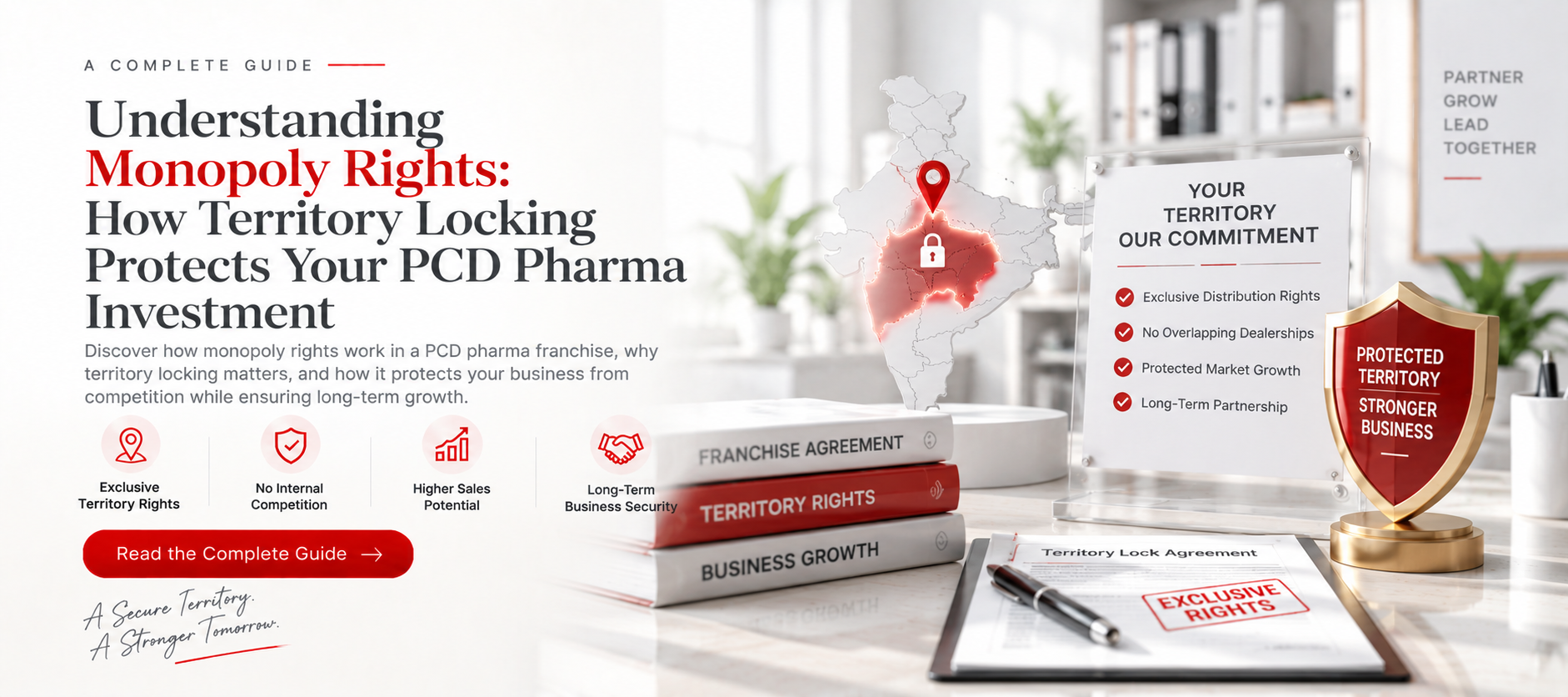
When you start a PCD pharma franchise business, you invest time, capital and effort into building doctor relationships, retailer networks and product demand in your local market. Monopoly rights—or territory locking—are designed to protect that effort by defining where you can market the company's products and whether another franchise partner can be appointed in the same area.
However, not every “monopoly” offer provides the same level of protection. Some rights are district-based, some are city-based, some apply only to selected products, and some are conditional on order volume or payment discipline. The only way to protect your investment is to understand the terms clearly and get them documented in writing.
1. What Are Monopoly Rights in a PCD Pharma Franchise?
Monopoly rights in a PCD pharma franchise are commercial rights given by a pharmaceutical company to a franchise partner for a defined territory. In simple terms, the company agrees not to appoint another partner for the same agreed products in the same territory, subject to the conditions listed in the agreement.
These rights allow a franchise partner to develop the market without directly competing with another franchise partner of the same company. This is especially important when you are investing in doctor visits, visual aids, samples, local promotions and retailer relationships.
| Territory Model | How It Works | Partner Impact |
|---|---|---|
| Exclusive Monopoly Territory | The company appoints one authorised partner for agreed products in a defined territory. | Offers stronger protection from internal competition, subject to agreement conditions. |
| Non-Exclusive Territory | More than one partner may be appointed in the same city, district or market. | Can create price competition and overlap in doctor or retailer coverage. |
| Product-Specific Monopoly | Exclusivity applies only to listed brands, divisions or product segments. | You may have exclusive rights for selected products but not the entire company catalogue. |
| Conditional Monopoly Territory | Rights continue only when the partner meets order, payment or activity conditions. | Requires regular review of targets, payment discipline and written renewal terms. |
2. Why Territory Locking Matters for Your PCD Pharma Investment
Building a pharmaceutical market takes time. A partner may spend months meeting doctors, introducing products to chemists, arranging local stock availability and following up on prescriptions. Without territory protection, another franchise partner from the same company may enter the same market and benefit from the awareness you created.
A properly structured monopoly territory can help protect:
- Your marketing investment: Doctor calls, samples, visual aids, local meetings and travel expenses are more meaningful when you are building your own territory.
- Your retailer relationships: Retailers are less likely to face confusion when one authorised partner manages availability and commercial communication.
- Your pricing discipline: Multiple company-appointed sellers in one area can lead to unnecessary discounting and lower margins.
- Your long-term market development: You can gradually expand your portfolio and field coverage without fear of internal overlap.
- Your repeat-order potential: Consistent supply and doctor follow-up are easier to manage in a clearly defined area.
Before selecting a territory, review your capital, doctor reach and product focus. Our guide on choosing the best PCD pharma product portfolio for your region can help you match your market opportunity with the right therapeutic categories.
3. How Should a PCD Pharma Territory Be Defined?
The most important clause in a monopoly agreement is the territory definition. Vague wording such as “exclusive rights for your area” creates room for misunderstanding. Your agreement should clearly state the exact geographic boundaries allotted to you.
Common ways PCD territories are defined
The franchise partner receives rights for an entire district. This can work well where the partner has strong local distribution capacity and doctor coverage.
The partner is allotted a city, town or municipal area. This is common in urban locations where a district may be too large for one operator.
Rights are assigned for clearly listed pin codes. This model can reduce confusion in metro cities and large districts.
Smaller geographic areas are allotted in rural or semi-urban markets. This may be suitable for partners beginning with lower investment capacity.
The best territory size is not always the largest territory. It is the territory you can actively serve. A smaller area with 100 reachable doctors and strong pharmacy coverage can be more profitable than a large district that you cannot visit consistently.
4. Monopoly Rights Must Also Define the Product Range
A common misunderstanding occurs when a partner believes they have exclusive rights for the entire company, but the agreement only covers a selected division or product range. For example, you may have monopoly rights for general medicines but not for dermatology, nutraceuticals, injectables or a newly launched product range.
To avoid confusion, the agreement should clearly address:
- Whether rights apply to the full catalogue or only a selected product list.
- Whether future product launches will automatically be included in your territory.
- Whether other divisions, sub-brands or marketing entities may appoint separate partners.
- Whether the same molecule can be marketed under another brand in your area.
- Whether institutional, hospital, e-commerce or direct company sales are excluded from your territory rights.
| Question to Ask | Why It Matters |
|---|---|
| Does my territory cover the complete product catalogue? | Prevents assumptions about products or divisions not mentioned in the agreement. |
| Are upcoming product launches included? | Helps you plan future growth in your market. |
| Can the company appoint another partner for a separate division? | Clarifies possible overlap in the same doctor and chemist network. |
| Are online, institutional or hospital sales excluded? | Defines situations where the company may serve customers directly. |
5. Why a Written Monopoly Agreement Is Essential
In business, verbal commitments are difficult to verify later. A professional PCD pharma company should provide a written appointment letter, territory confirmation or franchise agreement that identifies the parties and records the applicable commercial terms.
Your agreement does not need to be unnecessarily complex, but it should be clear. At minimum, it should include the following information:
6. Understand Minimum Order and Performance Conditions
Some PCD pharma companies offer monopoly territories subject to reasonable business conditions. The company may expect the partner to maintain regular orders, clear payments on time, actively develop the market or meet agreed minimum purchase levels.
These conditions are not automatically negative. A company may need them to ensure that territories are actively served and products remain available to doctors and retailers. The issue is whether the conditions are realistic, clearly written and fairly applied.
Before accepting performance conditions, ask:
- Is there a minimum opening order value?
- Is there a monthly, quarterly or annual purchase target?
- What happens if a target is not achieved for one month due to seasonality or delayed payments from the market?
- Is there a written warning period before territory rights are withdrawn?
- Can the company appoint another partner immediately, or will the current partner receive an opportunity to improve?
- Are payment delays, product unavailability or dispatch delays considered fairly in performance reviews?
For a deeper financial view, read our guide on average profit margins in a PCD pharma franchise.
7. How to Verify Territory Availability Before Investing
Before making an advance payment or placing your first order, verify that the territory is actually available. A professional process reduces the risk of receiving unclear or overlapping rights.
Provide your target state, district, city, tehsil and pin code. Broad requests such as “I need Maharashtra” are difficult to assess accurately.
Ask the PCD company to confirm in writing whether the territory is available for your selected product range.
Confirm whether availability applies to the complete catalogue or only selected divisions, brands or therapeutic ranges.
Review minimum order, payment, performance, expiry and breakage terms before accepting the territory.
Ensure that the final appointment letter or agreement contains the same territory information discussed during the enquiry stage.
Save the agreement, email confirmations, price lists, invoices and official communications in one secure folder.
8. Why Discuss Monopoly Opportunities with Mensa Medicare?
Choosing a PCD pharma company is about more than product prices. You need a partner that communicates clearly, provides relevant product information, supports orderly onboarding and explains commercial terms before you commit your capital.
Mensa Medicare works with franchise and distribution enquiries across India. Prospective partners can contact the team to discuss product categories, current territory availability, documentation requirements and commercial information relevant to their target market.
When evaluating a PCD opportunity with Mensa Medicare, you can request:
- Current territory availability for your state, district or city.
- An updated product catalogue with compositions, dosage forms, packing and MRP details.
- Applicable PCD prices, commercial terms and order information.
- Clarification on monopoly territory terms and the products covered under the proposed arrangement.
- Information on promotional materials, product support and the process for building your local market.
- Guidance on documents generally required before starting pharmaceutical distribution activity.
9. Common Monopoly PCD Franchise Mistakes to Avoid
A phone call or WhatsApp message alone may not provide enough clarity. Ask for formal written confirmation that defines the territory and products covered.
You may receive rights for only one division or selected products. Check whether your rights cover the entire portfolio, new launches and related brands.
A large district looks attractive, but it can become unmanageable without sufficient capital, field staff and supply capability. Start with a territory you can serve consistently.
Some partners focus only on monopoly status and skip the minimum-order or payment requirements. Review all conditions before signing.
Territory rights do not eliminate inventory risk. Understand how unsold, near-expiry and transit-damaged stock will be handled.
Even a protected territory can fail if doctors prescribe products that local retailers cannot source. Maintain planned stock levels and reorder fast-moving products on time.
10. How to Protect Your PCD Pharma Investment After Territory Allotment
Once your territory is confirmed, the responsibility shifts to execution. Monopoly rights protect your area, but they do not create sales automatically. You must build demand, maintain supply and follow the agreement conditions.
To strengthen doctor adoption in your protected area, explore our guide on how to market and promote pharma products to local doctors effectively.
11. Final Checklist Before Taking a Monopoly PCD Territory
Before paying for an opening order or signing a franchise agreement, confirm the following points:
Check Monopoly PCD Territory Availability with Mensa Medicare
Share your target state, district, city or pin code to request product information, current territory availability and applicable commercial terms from the Mensa Medicare team.
Monopoly PCD Pharma Franchise FAQs
Monopoly rights are commercial territory rights granted by a PCD pharma company to a franchise partner for an agreed geographic area. The terms usually define whether the company will appoint another partner for the same products in that territory. These rights should be documented in writing.
Monopoly rights are generally contractual commercial rights, not a separate government licence. Their protection depends on the written agreement, including the exact territory, products covered, conditions, duration, renewal terms and the obligations of both parties.
Ask for written territory confirmation or a signed franchise agreement that clearly states the district, city, pin codes or localities allotted to you, whether the territory is exclusive, the product range covered, duration, performance conditions and the company's process for appointing new partners.
It depends on the terms of your agreement. A company may be able to appoint another partner if the territory is non-exclusive, if another product range is excluded from your rights, or if performance, payment or minimum-order conditions are not met. Review these clauses before investing.
The agreement should include the exact territory, product range, exclusivity status, appointment duration, order or performance expectations, pricing, payment terms, expiry and breakage policy, promotional support, termination rules, brand-use conditions and dispute-resolution terms.
Mensa Medicare evaluates PCD pharma franchise enquiries based on current territory availability, product range and commercial suitability. Prospective partners should contact the team to request written availability confirmation and applicable terms for their target district or state.