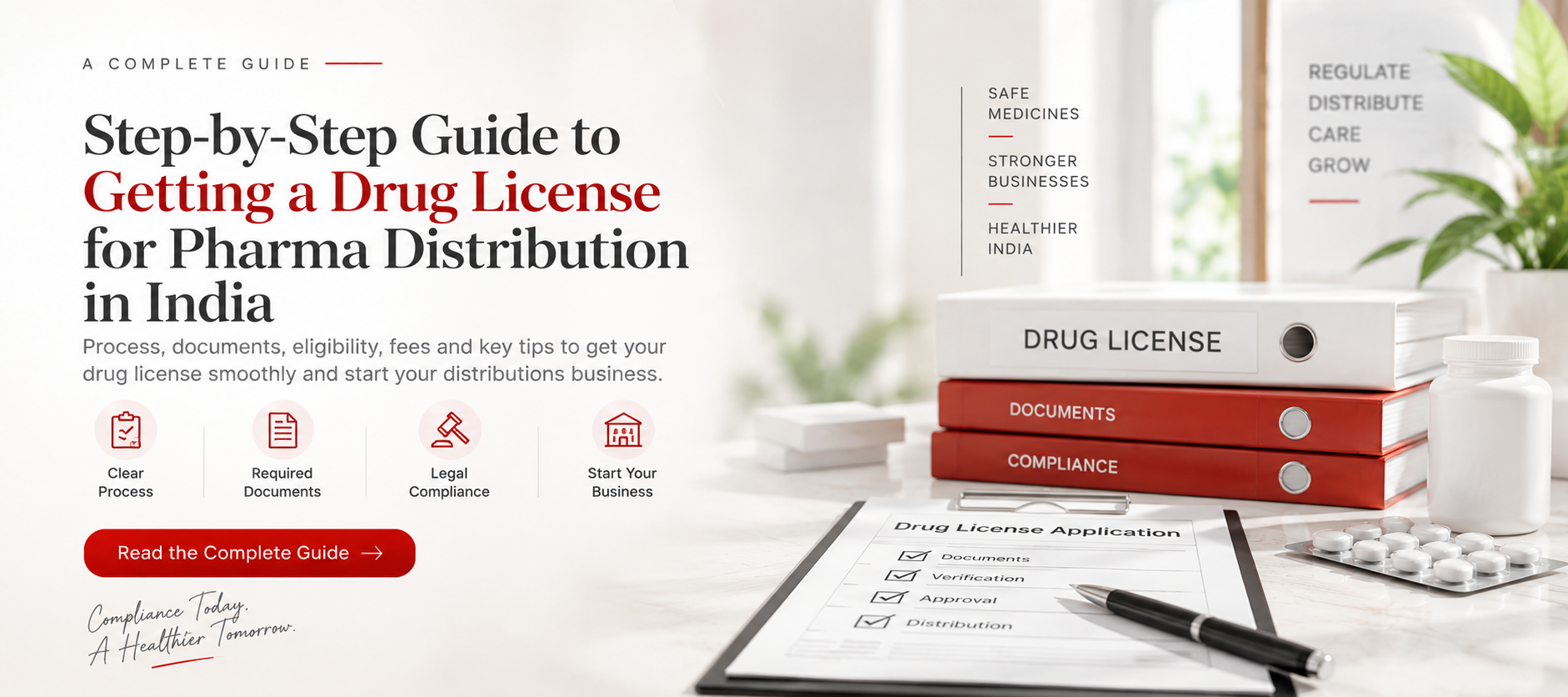
Starting a pharmaceutical distribution business or a PCD pharma franchise in India requires compliance with stringent regulatory frameworks. At the heart of this legal setup is the Wholesale Drug License issued by the state Food and Drug Administration (FDA).
Without a valid drug license, stocking, distributing, or selling pharmaceutical formulations is illegal under the Drugs and Cosmetics Act, 1940. This comprehensive guide walks you through the practical prerequisites, document checklist, application steps, and inspection process to help you secure your license smoothly.
1. What Is a Wholesale Drug License and Why Do You Need It?
A drug license is an official permit granted by the state licensing authority (FDA) to engage in the sale, stocking, or distribution of medicines. For B2B pharma distribution and PCD franchise partners, a Wholesale Drug License is mandatory.
Wholesale distribution licenses are primarily issued under two categories:
| License Form | Applicable For | Description |
|---|---|---|
| Form 20B | General Medicines | For wholesale of drugs other than those specified in Schedule C, C1, and X (general tablets, capsules, syrups, etc.). |
| Form 21B | Biological & Special Drugs | For wholesale of drugs specified in Schedule C and C1 (antibiotics, injectables, vaccines, biological formulations requiring cold chain). |
| Form 20-F / 21-C | Narcotic & Psychotropic | Required if dealing in Schedule X psychotropic substances (usually specialized institutional distribution). |
2. Premises Requirements: Size, Storage, and Infrastructure
The state FDA inspector checks your business premises rigorously before granting approval. Your distribution office or godown must meet specific infrastructure and storage standards:
- Carpet Area: The minimum required carpet area for a wholesale drug distribution office is generally 10 to 15 square meters. If you are handling both wholesale and retail, higher area stipulations apply.
- Storage Facilities: The premises must be clean, dry, well-ventilated, and protected from direct sunlight.
- Temperature Control: Since pharmaceutical products degrade in heat, you must install an adequate air-conditioning unit (AC) to maintain room temperature and a dedicated refrigerator for cold-chain products (like vaccines and certain injectables).
- Racks & Pallets: Medicines cannot be kept directly on the floor. Sturdy storage racks, pallets, and shelving systems are mandatory.
- Commercial Address: The premises must have a valid commercial address (not residential) with proper electricity connection and fire safety measures.
3. Responsible Personnel: Pharmacist or Competent Person
The Drugs and Cosmetics Act mandates that the storage and sale of drugs must be supervised by a qualified individual at all times. You must appoint:
| Designation | Qualification Requirement | Role & Responsibility |
|---|---|---|
| Registered Pharmacist | B.Pharm or D.Pharm registered with the State Pharmacy Council. | Direct supervision of dispensing, stocking, and quality control of pharmaceutical products. |
| Competent Person | Graduation with 1+ years of verified pharma sales/distribution experience (norms vary by state FDA). | Authorized supervisor for wholesale transactions when a pharmacist is not required full-time. |
4. Complete Checklist of Documents Required
Preparing an accurate documentation dossier is crucial for speedy approval. Gather the following documents before initiating your online application:
5. Step-by-Step Application Process
While the exact portal varies by state (e.g., e-Aushadhi in Maharashtra/Rajasthan, SUGAM or state single-window portals), the application workflow follows these standard steps:
Create an account on your state's official Food and Drug Administration online licensing portal using your corporate email and mobile number.
Select Form 20B/21B wholesale application, fill in firm details, enter pharmacist credentials, and pay the requisite government fee online.
Upload scanned copies of all legal documents, blueprints, photographs, and qualification certificates in prescribed PDF/JPEG formats.
An FDA Drug Inspector will review your file online and subsequently visit your premises to inspect storage conditions, space, and compliance.
Upon successful inspection and query resolution, the state FDA authority will approve and issue your wholesale drug license digitally.
6. The FDA Inspection: What Drug Inspectors Look For
The physical inspection is the most critical milestone. When the Drug Inspector visits your distribution godown or office, they will check:
- Carpet Area & Cleanliness: Is the space adequate and free of clutter or dampness?
- Cold Chain Equipment: Is the refrigerator operational with a working thermometer/data logger to monitor temperature?
- Invoices & Bill Books: Are proper purchase and sales billing books maintained (if renewing or upgrading)?
- Pharmacist Presence: Is the registered pharmacist or competent person present during the inspection?
- Storage Practices: Are products organized by category, with expired or damaged goods stored in a separate, clearly marked quarantine rack?
7. Ongoing Compliance and Maintenance
Securing your drug license is only the beginning. To keep your distribution business legally sound, maintain the following compliance practices:
- Maintain Proper Invoices: Keep all purchase invoices from certified pharma companies (like Mensa Medicare) and sales invoices to retailers for at least 3 years.
- Batch Tracking: Maintain records of batch numbers, manufacturing dates, expiry dates, and quantities for every product received and sold.
- Cold Chain Records: Log refrigerator temperatures daily, especially for temperature-sensitive injectables and biologicals.
- Renewal & Retention Fees: Pay timely retention fees (typically every 5 years) to prevent license lapse.
- FDA Intimations: Notify the FDA immediately if there is any change in directors, partners, pharmacists, or business address.
8. Common Mistakes to Avoid
Avoid these frequent pitfalls that cause application rejections or delays:
Ready to Launch Your Pharma Distribution Business?
Partner with Mensa Medicare for high-quality formulations, monopoly PCD franchise rights, and complete documentation support.
9. Conclusion
Obtaining a wholesale drug license for pharma distribution requires careful preparation, adherence to premises norms, and precise documentation. By following this step-by-step process and ensuring strict compliance with state FDA guidelines, you can secure your license without unnecessary delays.
Once your drug license is in hand, you are fully equipped to partner with a certified pharmaceutical company like Mensa Medicare, establish your monopoly territory, and build a thriving, legally compliant PCD pharma franchise business.
FAQs on Drug License for Pharma Distribution
A wholesale drug license typically consists of Form 20B (for general drugs) and Form 21B (for biologicals, antibiotics, and products in Schedule C and C1).
Yes, if you do not have a B.Pharm or D.Pharm degree, you can appoint a "Competent Person" who has verified pharmaceutical sales or distribution experience, subject to state FDA approval guidelines.
Government official fees vary by state, usually ranging between ₹3,000 to ₹7,000 for Form 20B and 21B. Professional or consultant charges (if hired) are separate.
No. State FDAs mandate that wholesale drug distribution premises must have a valid commercial address with appropriate storage infrastructure and zoning compliance.
Wholesale drug licenses in most states remain valid indefinitely as long as periodic retention fees (usually every 5 years) are paid on time and regulatory compliance is maintained.
A wholesale drug license is a mandatory legal prerequisite to purchase stock from pharma companies, bill to retail chemists, and legally operate your PCD franchise territory.