If you are planning to enter the pharmaceutical business in India, you will quickly come across two common models: the PCD pharma franchise and the pharma distributorship. Many new entrepreneurs assume they are the same thing—because both involve buying medicines from a company and selling them in a territory. In practice, they are structurally different businesses with different investment levels, responsibilities, margins and growth paths.
Choosing the wrong model for your capital and experience is one of the most expensive mistakes in this industry. This guide explains exactly how the two models differ, who each model suits, and how to evaluate opportunities from companies like Mensa Medicare before you invest.
1. What Is a PCD Pharma Franchise?
PCD stands for Propaganda-Cum-Distribution. In a PCD pharma franchise, a pharmaceutical company authorises an individual or firm to promote and distribute its products in a defined territory, using the company's brand names and product range. The franchise partner earns from the margin between the PCD purchase price and the price at which products are supplied to retailers, dispensing doctors or stockists.
The defining characteristics of a PCD franchise are its smaller scale and marketing focus. The partner's main job is demand generation—meeting doctors, promoting products, building chemist relationships and converting prescriptions into orders. The company supports this with promotional materials such as visual aids, samples, product cards and literature.
Typical features of a PCD pharma franchise
- Lower investment: Often started with a modest opening order compared to a distributorship.
- Monopoly territory rights: Usually a district, city or pin-code area with exclusivity, subject to agreement terms.
- Lower minimum order quantity (MOQ): Companies accept smaller orders per product, making entry easier.
- Company promotional support: Visual aids, samples, MR bags, reminder cards and product literature are commonly provided.
- Higher percentage margins: PCD price lists generally leave a wider margin between purchase price and market supply price.
- Flexible operations: Can often be managed by a small team or even a single experienced person initially.
2. What Is a Pharma Distributorship?
A pharma distributorship is a supply-chain-driven business model. A distributor (also called a stockist in many markets) purchases medicines in bulk directly from a pharmaceutical company or its C&F (Carrying and Forwarding) agent and supplies them to retail pharmacies, hospitals, nursing homes, clinics and sometimes sub-stockists across a wider territory.
The distributor's main job is availability and logistics—keeping sufficient stock, billing retailers quickly, managing credit cycles and ensuring products reach every corner of the allotted territory. Demand generation is usually handled by the company's own medical representatives, while the distributor focuses on fulfilment.
Typical features of a pharma distributorship
- Higher investment: Bulk opening stock, larger storage and bigger working capital for market credit.
- Wider territory: Often a full district, multiple districts or a region, usually without the tight monopoly structure of PCD.
- Higher MOQ: Companies expect meaningful order volumes per product to justify the distributor rate.
- Lower percentage margins, higher volumes: Distributors work on thinner margins compensated by large turnover.
- Credit management: Retailers typically buy on 15–45 day credit, so significant capital stays blocked in the market.
- Operational infrastructure: Requires proper storage, billing systems, delivery arrangements and often staff.
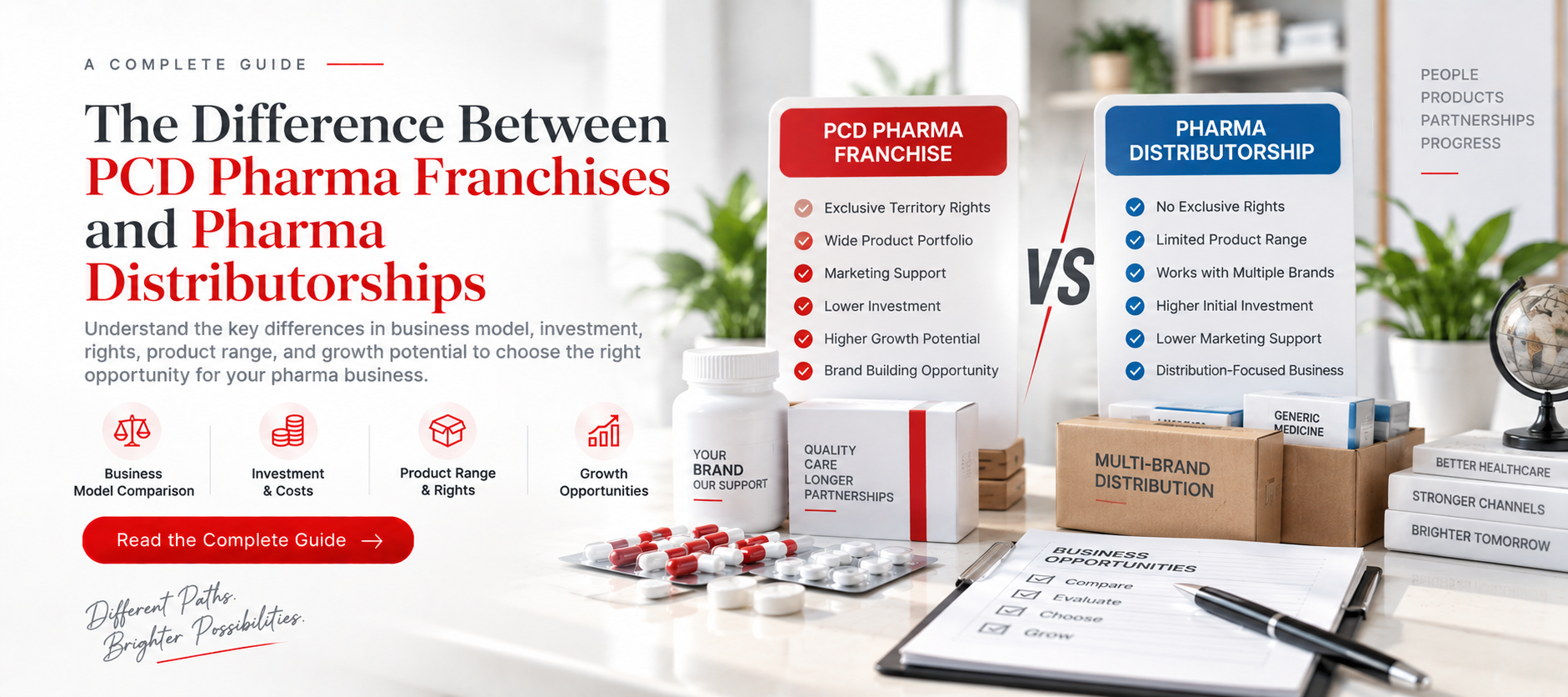
3. PCD Pharma Franchise vs Pharma Distributorship: Complete Comparison
This side-by-side comparison summarises the practical differences between the two models. Exact numbers vary by company, state and product range, so always confirm commercial terms in writing before investing.
| Factor | PCD Pharma Franchise | Pharma Distributorship |
|---|---|---|
| Core Role | Product promotion and demand generation in a defined territory. | Bulk stocking and supply to retailers, hospitals and sub-stockists. |
| Typical Investment | Lower — often starts with a modest opening order plus licence and basic setup. | Higher — bulk stock, storage, delivery setup and large credit exposure. |
| Territory Size | Smaller and focused: a district, city, tehsil or pin-code cluster. | Larger: one or more districts, sometimes a full region. |
| Monopoly / Exclusivity | Usually offered as monopoly rights for the allotted territory, subject to agreement conditions. | Often non-exclusive or shared with company-appointed structures; terms vary by company. |
| Minimum Order Quantity | Low — companies accept smaller quantities per product. | High — bulk quantities expected to qualify for distributor rates. |
| Margin Structure | Higher percentage margin on moderate volumes. | Lower percentage margin on high volumes. |
| Promotional Support | Visual aids, samples, product cards, MR bags and literature usually provided. | Limited; promotion is largely handled by the company's own field force. |
| Who Generates Demand | The franchise partner builds doctor and chemist relationships directly. | Mostly the company's marketing team; the distributor ensures supply. |
| Credit Risk | Moderate — credit given to a limited set of retailers and doctors. | High — large outstanding amounts across many retail counters. |
| Team Requirement | Can begin with the owner alone or a small team. | Usually needs staff for billing, delivery, accounts and recovery. |
| Best Suited For | New entrepreneurs, MRs starting their own business, small investors with local doctor access. | Established traders, experienced pharma professionals, investors with strong capital and infrastructure. |
4. Investment Difference: What Your Money Actually Goes Into
The investment difference between the two models is not just about the size of the first order. It is about where the money gets locked and for how long.
Opening stock at PCD rates, drug licence and premises compliance, basic storage, promotional visits, samples support and limited retailer credit.
Bulk stock at stockist rates, larger godown and racks, delivery vehicle or logistics, billing software and staff, plus heavy working capital blocked in retailer credit cycles.
Shorter cycle if you supply a focused set of counters and collect payments on time. Easier to rotate capital with disciplined reorders.
Longer cycle because dozens or hundreds of retailers buy on credit. A profitable distributor can still face cash pressure if receivables slip.
If capital is limited, it is usually wiser to start lean. Our guide on starting a PCD pharma franchise business with low investment explains how to structure an entry without overcommitting funds.
5. Territory Rights and Margin Structure Compared
Territory rights
In a PCD model, territory protection is a central part of the offer. Companies commonly grant monopoly rights for a defined district or area, documented in an appointment letter or agreement. This protects the partner's marketing investment from internal competition. To understand how this protection actually works, read our detailed guide on monopoly rights and territory locking in PCD pharma.
In a distributorship, territory is usually allocated for supply coverage rather than exclusive market development. Depending on the company's structure, a distributor may share the market with other trade channels, institutional supplies or company-handled key accounts. Exclusivity, where offered, is tied closely to volume commitments.
Margin structure
The two models earn money differently:
Distributor earning = Lower margin % × Large, channel-driven volume
For example, a PCD partner may earn a wider gap between PCD price and supply price on a smaller number of products, while a distributor earns a thin margin on thousands of strips moving through the trade channel every month. Neither is automatically “better”—the right question is which cost structure and workload matches your resources. For a realistic financial picture, see our guide on average profit margins in a PCD pharma franchise.
6. Documents and Licensing: Is There a Difference?
This is one of the most misunderstood areas. The licensing requirement does not depend on whether you call yourself a “franchise” or a “distributor.” It depends on what activity you perform.
| Requirement | PCD Franchise Partner | Pharma Distributor |
|---|---|---|
| Wholesale Drug Licence | Required if you purchase, store, invoice or supply medicines in your own firm's name. | Required — bulk storage and wholesale supply are the core of the business. |
| GST Registration | Commonly required for taxable commercial transactions and invoicing. | Required for high-volume taxable supply and input tax credit flow. |
| Business Entity Proof | Proprietorship, partnership, LLP or company documents as applicable. | Same, though companies often prefer established firms for large territories. |
| Storage Compliance | Modest licensed premises with racks and refrigeration where applicable. | Larger compliant godown with capacity for bulk and cold-chain stock. |
| Company Agreement | Franchise appointment letter with territory, products and commercial terms. | Stockist/distributor appointment with supply terms, credit policy and targets. |
For full details, read our guides on getting a drug licence for pharma distribution and the documents required to partner with a certified PCD pharma company.
7. Which Model Is Right for You?
Neither model is universally better. The right choice depends on your capital, experience, network and appetite for operational complexity.
Choose a PCD pharma franchise if you:
- Are a first-time entrepreneur or a medical representative starting your own venture.
- Have limited capital and want to start lean with a manageable opening order.
- Have strong relationships with doctors in a specific district or city.
- Prefer marketing and relationship-building over logistics and volume management.
- Want monopoly territory protection for the market you develop.
Choose a pharma distributorship if you:
- Have substantial capital for bulk stock and extended retailer credit.
- Already have trade relationships with a large number of chemists.
- Can manage staff, billing systems, delivery logistics and recovery follow-ups.
- Prefer a volume-and-rotation business over a promotion-led business.
- Have the infrastructure to store and move large quantities compliantly.
8. Common Mistakes When Choosing Between the Two Models
There is no separate “PCD licence” or “distributor licence.” The same wholesale drug licence framework applies based on the activity you perform. Understand this before paying anyone for a “franchise licence.”
Bulk stock plus long retailer credit cycles can exhaust limited capital within months. If funds are tight, a focused PCD franchise is usually the safer entry point.
In PCD, you are the field force. Partners who wait for the company to generate prescriptions usually stall. Budget your own doctor coverage from day one.
Distributors fail more often from blocked receivables than from low sales. Fix credit days, follow up weekly and never let one retailer hold a disproportionate share of your capital.
Whether franchise or distributorship, get the price list, territory terms, payment conditions, expiry policy and support commitments in writing before transferring any advance.
9. Explore Both Models with Mensa Medicare
Whether you are evaluating a PCD pharma franchise for your district or a distribution arrangement for a wider territory, the most important first step is an honest discussion about your capital, market access and goals. Mensa Medicare works with pharma entrepreneurs across India and can help you understand which structure fits your situation.
When you contact the Mensa Medicare team, you can request:
- Guidance on whether a PCD franchise or distribution model suits your investment capacity and territory.
- The updated product catalogue with composition, packing and price structures relevant to your chosen model.
- Current territory availability for monopoly PCD rights in your district or city.
- Clear commercial terms—order quantities, payment terms, schemes and support—in writing before you commit.
- Information on promotional materials and onboarding documentation for new partners.
- A transparent view of quality standards and supply reliability so you can plan your market with confidence.
10. Final Decision Checklist: PCD or Distributorship?
Answer these questions honestly before choosing your model:
Not Sure Which Model Fits You? Talk to Mensa Medicare
Share your target territory, investment capacity and experience—our team will help you evaluate PCD franchise and distribution options with transparent commercial terms.
PCD Franchise vs Distributorship — FAQs
A PCD pharma franchise is a smaller, marketing-focused model where the partner promotes the company's products in a defined territory, usually with monopoly rights, lower investment and lower minimum order quantities. A pharma distributorship is a larger, supply-chain-focused model where the distributor purchases stock in bulk and supplies retailers, hospitals and sub-stockists across a wider territory with higher investment and volume-based margins.
A pharma distributorship generally requires higher investment because of bulk stock purchases, larger storage, wider territory coverage and working capital for retailer credit. A PCD pharma franchise can typically be started with a lower investment because of smaller opening orders and company-provided promotional support.
If either business purchases, stores, invoices or supplies medicines in its own name, the applicable wholesale drug licence from the State Drug Control Authority is generally required. The licensing requirement depends on the role performed, not on whether the business calls itself a franchise or a distributorship.
PCD pharma franchises generally work on higher percentage margins with moderate volumes, while distributors work on lower percentage margins with much higher volumes. Actual take-home profit in both models depends on product mix, credit control, expenses and inventory management.
Yes. Many successful pharma entrepreneurs start with a PCD franchise to learn the market with lower risk, build doctor and retailer networks, and later expand into a full distributorship or appoint sub-stockists as their capital and territory experience grow.
Mensa Medicare handles PCD pharma franchise and distribution-related enquiries across India. Prospective partners can contact the team to discuss the business model that fits their investment capacity, territory and experience, along with product catalogue and current availability.