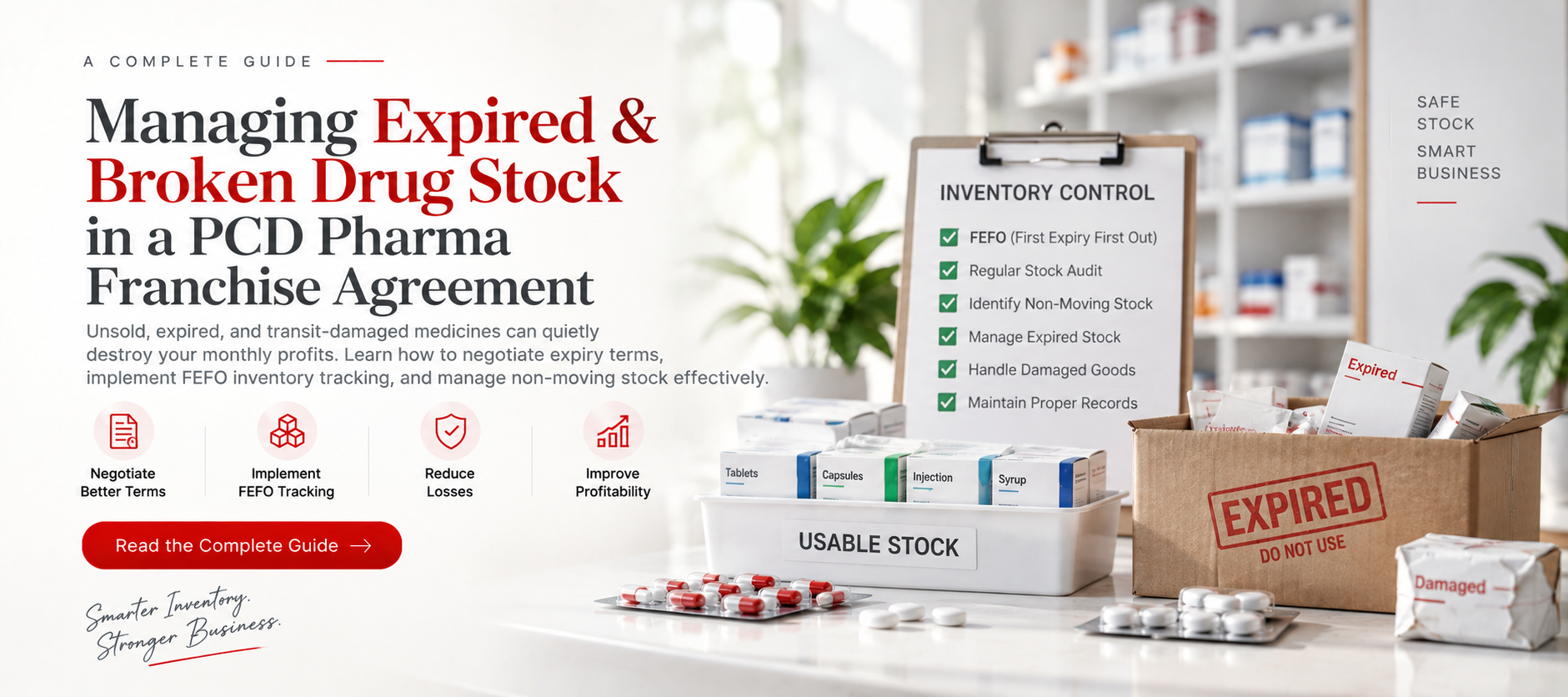
In the pharmaceutical distribution business, you are dealing with perishable goods. Unlike electronics or hardware, medicines have a strict shelf life. Every strip of tablet or bottle of syrup that crosses its expiry date in your godown represents a 100% loss of your invested capital for that unit.
For a PCD pharma franchise partner, managing expired, near-expiry, and broken stock is just as critical as generating sales. A territory might look highly profitable on paper, but if 10% of the inventory expires unsold or is damaged in transport without a clear refund policy, those average profit margins will vanish quickly. This guide breaks down how these issues are legally handled in a PCD agreement and how to protect your working capital.
1. Why Expiry and Breakage Policies Make or Break Your Profitability
When you purchase stock from a PCD pharma company, you are paying upfront or on a short credit cycle. If a retailer returns expired stock to you after 18 months, you must refund or replace it for the retailer to maintain relations. But will your parent PCD company refund you?
The answer lies entirely in your signed PCD Franchise Agreement. Many new entrepreneurs assume that parent companies take back all expired goods by default, just like massive multinational corporations do for their C&F agents. However, the PCD monopoly model operates differently. Because PCD companies offer products at highly discounted Net Rates (PTS), they often do not build the cost of expiry into their pricing.
2. Common Expiry Policies in PCD Pharma Agreements
Before you place your first order, you must ask the company: "What is your written policy on non-moving and expired stock?" Generally, PCD companies operate on one of three standard models:
| Policy Type | How It Works | Impact on Franchise Partner |
|---|---|---|
| 1. No Replacement Policy | Goods once sold are not taken back. The franchise partner bears 100% of the risk for unsold/expired stock. | High risk. Requires extremely tight inventory control and cautious ordering. Usually comes with the lowest purchase prices. |
| 2. Partial Credit Note (Common) | The company takes back expired goods and issues a credit note (e.g., 50% of the PTS value) against future purchases. | Balanced risk. You recover half your capital, incentivizing both parties to prevent expiry. Usually requires goods to be returned 3 months before expiry. |
| 3. Full Replacement (Rare in PCD) | The company replaces expired stock with fresh stock of the same value. | Low risk for the partner, but the company usually charges a much higher initial product price to cover this liability. |
Note: Even companies that offer a Credit Note will require you to pay the reverse GST and the return freight charges. It is almost always cheaper to liquidate stock locally than to send it back.
3. How to Handle Transit Breakage and Shortages
Medicines—especially glass bottles (syrups, injectables)—travel hundreds of kilometers via third-party logistics. Breakage, leakage, and box shortages happen. To ensure the parent company replaces damaged goods, you must follow a strict legal protocol upon delivery.
When the transporter arrives, check the external condition of the corrugated boxes. Look for wet spots, crushed corners, or opened tape.
If a box is damaged, write "Box damaged/wet, accepted subject to verification" on the transporter's Lorry Receipt (LR) before signing it.
Record a continuous video while opening the damaged box. Take clear photographs of the broken bottles showing the batch number and label.
Email or WhatsApp the evidence to the PCD company immediately. Most agreements strictly state that breakage claims are void if reported after 48 hours.
4. The First-Expired, First-Out (FEFO) Inventory Rule
A common mistake in warehouse management is following FIFO (First-In, First-Out) instead of FEFO (First-Expired, First-Out).
In pharma, the date you receive a box is irrelevant; the date the medicine expires is what matters. If you receive a fresh batch of Paracetamol with an expiry of Dec 2028, and a week later you receive another batch expiring in Aug 2028, the August batch must be placed at the front of the rack and dispatched to chemists first.
- Rack Organization: Always load new stock from the back of the shelf and pick stock from the front.
- Software Tracking: Use a pharmaceutical billing software (like Marg ERP) that forces you to select the batch with the nearest expiry date during invoicing.
5. Managing Near-Expiry and Non-Moving Stock
Stock is considered "near-expiry" when it has 6 to 8 months of shelf life remaining. Most retail chemists will refuse to accept stock that has less than 6 months left. If you have stock sitting idle at the 8-month mark, you must act aggressively.
- Identify Non-Movers Early: Review your inventory software every month. If a product hasn't moved in 90 days, flag it.
- Run Special Schemes: Offer a temporary 10+2 or 10+3 scheme to your fastest-moving retailers or dispensing doctors to liquidate the stock quickly.
- Communicate with Your PCD Company: If you realize you ordered the wrong product portfolio for your region, ask the company if they can exchange the fresh, non-moving stock for faster-moving items (subject to freight costs).
6. Regulatory Rules for Expired Medicine Disposal
If you fail to liquidate stock and it crosses its expiry date, you cannot simply throw it in the municipal garbage. Under the Drugs and Cosmetics Act (Schedule M) and biomedical waste guidelines, you are legally responsible for safe disposal.
- Segregation: Expired drugs must be immediately removed from the active selling racks and kept in a locked, marked cupboard labeled "Expired Stock - Not For Sale".
- Documentation: Maintain an "Expiry Destruction Register" noting the product name, batch number, quantity, and value.
- Destruction: Depending on your state's Drug Control Office guidelines, destruction may require handover to a certified biomedical waste management company (e.g., Ramky) who will issue a destruction certificate.
Understanding these compliance factors is a crucial part of securing and maintaining your wholesale drug license.
7. Common Mistakes in Managing Pharma Inventory
Buying 1,000 boxes of a slow-moving syrup just to get a "20% extra free" scheme. If 400 boxes expire, the scheme actually cost you money.
Failing to collect near-expiry stock from your chemists in time. If a chemist holds stock until the expiry month, you lose the window to liquidate it elsewhere.
Signing the transporter's receipt blindly and discovering broken injectables a week later when preparing a local dispatch. The company will deny the claim.
Not using batch-tracking software. Human memory cannot accurately track the expiry dates of 150 different products across 400 different batches.
8. Checklist: What to Look for in Your PCD Agreement
Before partnering with a PCD pharma company, ensure these clauses are documented in writing (email or formal agreement):
Partner with a Transparent PCD Company
At Mensa Medicare, we believe in clear, fair, and documented policies for our franchise partners. Request our product catalogue and commercial terms today.
Expiry & Breakage Management FAQs
It depends entirely on your franchise agreement. Many monopoly PCD pharma companies do not offer 100% replacement to keep initial product prices low. Some offer a 50% credit note on the PTS (Price to Stockist), while others have a strict 'no return, no replacement' policy. Always confirm this in writing before investing.
Typically, the PCD pharma company will bear the loss or replace the goods IF the breakage is reported immediately upon delivery (usually within 24 to 48 hours) with photographic evidence and a remark on the transporter's receipt (LR). If reported late, the franchise partner bears the loss.
FEFO stands for First-Expired, First-Out. It is an inventory management rule where products with the earliest expiry dates are sold and dispatched first, regardless of when they were received in the warehouse. This minimizes the risk of stock expiring on your shelves.
Avoid bulk-buying slow-moving items just to get a discount. Order based on a 45-day sales cycle, implement FEFO in your storage racks, track batch expiries monthly, and actively promote 'near-expiry' stock (6-8 months left) to fast-moving counters with temporary schemes.
No. Under the Drugs and Cosmetics Act (Schedule M) and bio-medical waste guidelines, expired pharmaceutical products must be segregated, marked 'Expired - Not for Sale', and destroyed safely, often requiring a destruction certificate or handover to authorized waste management agencies.