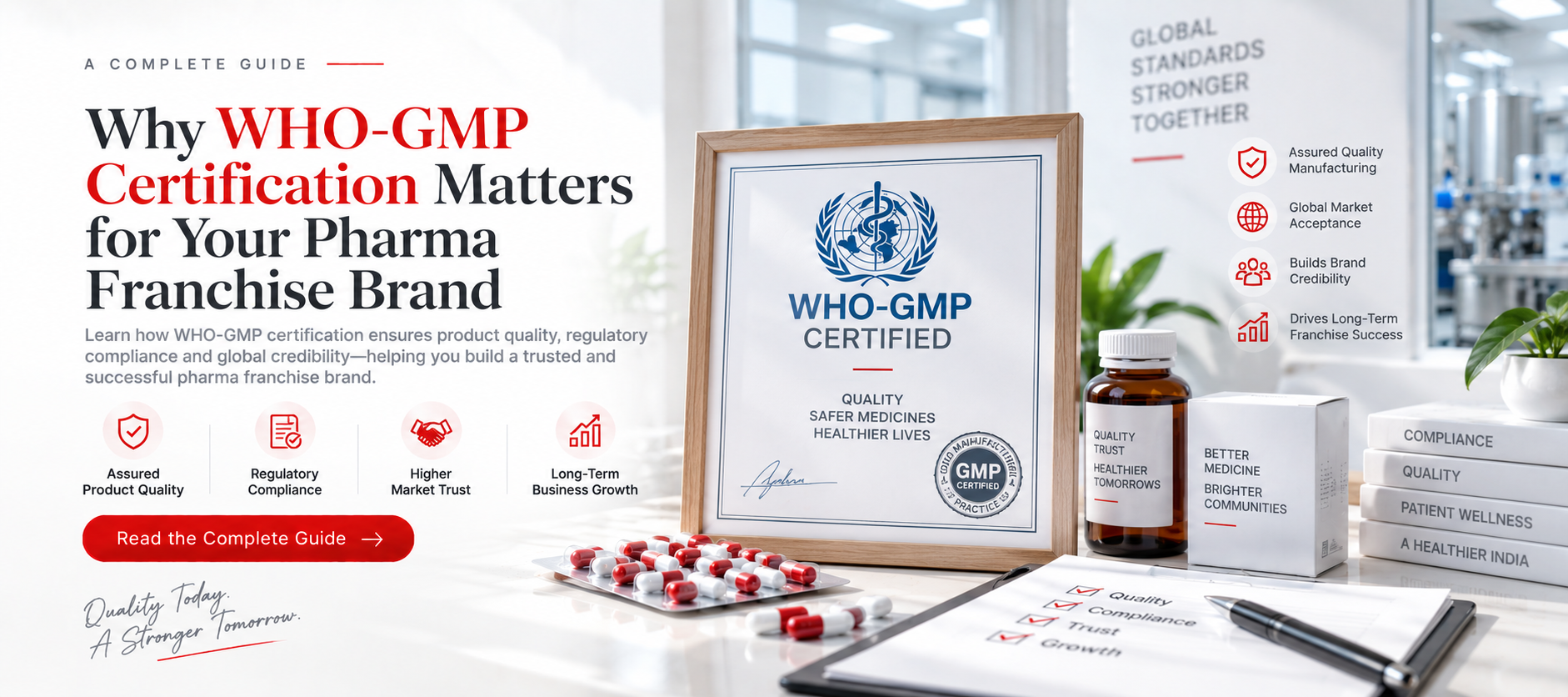
When a PCD pharma franchise partner starts a business, the biggest asset being built is not stock—it is trust. Doctors trust you when they prescribe your products. Retailers trust you when they stock your brands. Patients trust the medicine when it works consistently. All of that trust rests on one foundation: manufacturing quality.
This is exactly why WHO-GMP certification has become one of the most important things to check before selecting a PCD pharma company. A single batch of poor-quality product can undo months of doctor relationship-building in your territory. In this guide, we explain what WHO-GMP actually means, why it matters for your franchise brand, and how to verify it properly.
1. What Is WHO-GMP Certification?
GMP stands for Good Manufacturing Practices—a system of standards that ensures pharmaceutical products are consistently produced and controlled according to defined quality requirements. WHO-GMP refers to GMP standards based on World Health Organization guidelines.
In India, a WHO-GMP certificate is generally issued by the State Licensing Authority to a specific manufacturing site, for specified product categories, after inspection of the facility. It is site-specific and category-specific—not a generic company-wide badge.
What a GMP-compliant facility is expected to control
- Premises and layout: Clean, segregated production areas designed to prevent cross-contamination and mix-ups.
- Equipment and calibration: Validated machinery with documented cleaning and maintenance procedures.
- Raw material controls: Testing and approval of incoming active ingredients and excipients.
- Process documentation: Written procedures, batch manufacturing records and traceable production data.
- Quality control testing: In-process and finished-product testing before batch release.
- Personnel and training: Qualified staff with defined responsibilities and ongoing training.
- Storage and stability: Controlled storage conditions and stability data supporting shelf life.
2. Why WHO-GMP Matters Specifically for a PCD Franchise Partner
Here is the reality of the PCD model: you sell products you do not manufacture. The brand name on the strip belongs to the company, but the relationship with the doctor and the chemist belongs to you. When something goes wrong with product quality, the doctor does not call the factory—they call you.
| Quality Issue in the Field | Who Actually Faces the Consequence |
|---|---|
| Tablets crumbling or discolouring | The franchise partner faces retailer returns and loses shelf space at the counter. |
| Inconsistent therapeutic response | The doctor quietly stops prescribing and may switch to a competitor brand permanently. |
| Packaging or labelling defects | The partner handles chemist complaints, replacements and reverse logistics costs. |
| Batch complaints or quality queries | The partner must produce documentation and explain the issue in their own market. |
| Regulatory sampling issues | The partner's licensed premises and invoices come under scrutiny in the supply chain. |
In other words, manufacturing quality is a business risk carried by the franchise partner in the field. WHO-GMP compliance is one of the strongest available indicators that this risk is being actively managed at the source.
3. How Quality Certification Builds Your Local Brand Trust
Building a pharma brand in your district is a slow, cumulative process. Each of the following outcomes depends directly on product consistency:
Doctors evaluate a new brand over several patients. Consistent results across batches convert a trial prescription into a regular prescription habit.
Chemists stock brands that patients do not return and that move reliably. Quality complaints make retailers reluctant to reorder.
In chronic therapies like cardiac and diabetic care, patients continue for months or years. Consistent quality protects that long-term value.
Hospitals, nursing homes and tender-based buyers often ask for quality documentation before approving a supplier.
This chain is why experienced partners treat quality as a commercial advantage, not just a compliance formality. To see how prescription trust is actually built in the field, read our guide on marketing and promoting pharma products to local doctors effectively.
4. The Commercial Benefits of Partnering with a Quality-Focused Company
Beyond risk reduction, sourcing from a GMP-compliant, quality-focused manufacturer creates measurable business advantages for a PCD partner:
5. How to Verify a WHO-GMP Certificate Before Signing a Franchise
This is where most new partners go wrong. A logo on a website, a badge on a visiting card or a claim in a WhatsApp catalogue is not verification. Certificates are documents with specific details that can and should be checked.
| What to Check | Why It Matters |
|---|---|
| Manufacturing site address | Confirm the certificate belongs to the facility that actually manufactures your products—not an unrelated site. |
| Issuing authority | WHO-GMP certificates in India are typically issued by the State Licensing Authority. Check the authority named on the document. |
| Certificate number and date | Every legitimate certificate carries a reference number and issue date for traceability. |
| Validity period | Certificates expire. An outdated certificate does not demonstrate current compliance. |
| Product categories covered | Scope is category specific. A certificate covering tablets does not automatically cover injectables, creams or liquids. |
| Manufacturing licence reference | Cross-check the manufacturing licence number printed on your product labels against the documentation provided. |
6. Look Beyond the Certificate: Other Quality Signals to Check
A certificate is a starting point, not the whole picture. Experienced partners also evaluate the following practical quality indicators:
- Product labelling completeness: Batch number, manufacturing date, expiry date, manufacturing licence number, storage instructions and composition clearly printed.
- Batch documentation availability: Whether a Certificate of Analysis (COA) can be provided for a batch when genuinely required.
- Packaging quality: Blister integrity, printing clarity, carton strength and leak-proof bottles—especially important in dermatology and liquid products.
- Batch-to-batch consistency: Colour, size, coating and physical appearance should not vary noticeably between supplies.
- Remaining shelf life on dispatch: Adequate shelf life on arrival is a sign of well-managed production planning.
- Complaint handling process: Whether the company has a defined process for investigating and responding to quality queries.
- Supply consistency: Reliable dispatch is itself a quality-system indicator; frequent stock-outs often reflect weak planning.
These points should be part of your company verification process. For a complete list of what to collect before partnering, read our guide on documents required to partner with a certified PCD pharma company.
7. Red Flags: When Certification Claims Should Worry You
If a company repeatedly avoids sharing a certificate copy or gives vague answers about the manufacturing site, treat it as a serious warning sign.
If the manufacturing address on your product label differs from the certified site, the certification may not apply to your products at all.
Certificates without visible validity dates, or with lapsed validity, do not demonstrate current compliance status.
Being certified for oral solids says nothing about injectable or topical manufacturing. Match the scope to the products you intend to sell.
Quality systems, testing and documentation carry real cost. Prices far below the market norm alongside premium quality claims deserve careful scrutiny.
A quality-focused company will have a defined process for handling batch complaints. Verbal reassurance is not enough—get the policy in writing.
8. Why Mensa Medicare Is the Right PCD Pharma Partner for Quality-Conscious Entrepreneurs
Choosing a PCD pharma company is a long-term decision. The right partner should not only offer attractive margins—it should protect the reputation you are building in your district every single day.
Mensa Medicare India Private Limited is built around a simple principle: a franchise partner's success depends on product consistency and transparent communication. That is why the company focuses on quality-led sourcing, clear documentation and dependable supply rather than short-term volume pushes.
What makes Mensa Medicare a strong PCD partner
Products are sourced through manufacturing facilities operating under applicable GMP standards, with attention to formulation quality, packaging integrity and batch consistency.
Prospective partners can request applicable quality certification copies, product information and batch documentation details before committing to an order.
A diverse portfolio spanning general medicines, cardiac-diabetic care, dermatology, gastro, nutraceuticals and specialty segments to match your territory's needs.
Clearly documented territory allotment so your marketing investment is protected from internal competition in your district.
Marketing materials and product literature to support professional, ethical doctor engagement in your market.
Pricing, order terms, territory and policies shared in writing—so partners can evaluate the opportunity honestly before investing.
If you are still deciding on your business structure, our comparison guide on PCD pharma franchise vs pharma distributorship can help you choose the model that fits your capital and market access.
9. Quality Verification Checklist Before Taking a PCD Franchise
Run through this checklist before you place your first order with any PCD pharma company:
Partner with a Quality-Focused PCD Pharma Company
Request Mensa Medicare's product catalogue, applicable quality documentation and current monopoly territory availability for your district—before you invest a rupee.
WHO-GMP & Pharma Quality — FAQs
WHO-GMP refers to Good Manufacturing Practices based on World Health Organization guidelines. In India, a WHO-GMP certificate is generally issued by the State Licensing Authority to a specific manufacturing site for specified product categories, confirming that the facility follows defined standards for premises, equipment, processes, documentation, quality control and personnel.
A PCD franchise partner sells products under the manufacturing company's brand. If product quality is inconsistent, the franchise partner faces doctor complaints, retailer returns and loss of local reputation. Sourcing from a WHO-GMP compliant facility helps support consistent product quality, doctor confidence and long-term brand credibility in your territory.
All licensed manufacturers in India must comply with Good Manufacturing Practices under Schedule M of the Drugs and Cosmetics Rules. A WHO-GMP certificate is an additional site-specific certification often obtained for export purposes, tenders and quality assurance. Requirements depend on the product category, market and applicable regulations.
Request a copy of the certificate and check the manufacturing site address, issuing authority, certificate number, product categories covered and validity dates. Confirm that the certificate relates to the site actually manufacturing your products, and that the scope includes the dosage forms you plan to sell.
No. WHO-GMP certificates are site and category specific. A certificate may cover tablets and capsules but not injectables or other dosage forms. Always check the product categories listed in the certificate rather than assuming it applies to the entire catalogue.
Mensa Medicare places strong emphasis on quality-focused sourcing and transparent documentation. Prospective PCD partners can contact the team to request applicable quality certification copies, product information, batch documentation details and commercial terms relevant to their territory.